

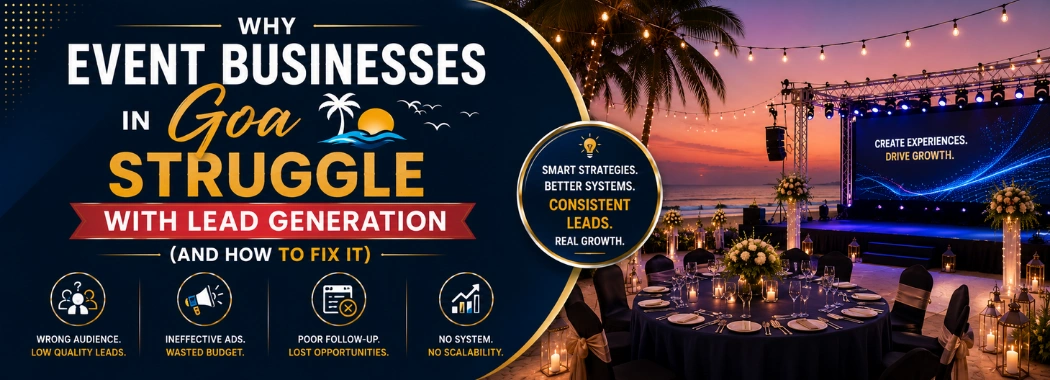
Goa’s event market is full of opportunity — yet most event businesses here struggle to get consistent, quality leads. Here’s the exact diagnosis and the fix that works.
What’s Inside
- Goa Has Every Condition for a Thriving Event Business — So Why Is Lead Generation So Hard?
- The Goa Context: Why This Market Creates Unique Lead Generation Challenges
- The Booking Engine: One System Addressing Eight Failure Modes
- The Diagnosis: Eight Reasons Event Lead Generation Fails in Goa
- The Fix: The Booking Engine — Built for Goa’s Specific Market
- A Diagnostic Checklist for Goa Event Businesses
- Frequently Asked Questions
- The Gap Between Goa’s Market Opportunity and Most Event Businesses’ Results Is Structural — and It Is Fixable
Goa Has Every Condition for a Thriving Event Business — So Why Is Lead Generation So Hard?
On paper, running an event business in Goa should be one of the more straightforward propositions in India’s event industry.
The destination sells itself. The venues are world-class. The demand — from domestic destination clients, international couples, corporate retreat planners, and social celebration organisers — is real and growing. The budgets in this market are among the highest of any event destination in the country. And the visual material produced by every event against Goa’s backdrop — the beaches, the colonial architecture, the resort settings, the tropical light — is inherently compelling content.
And yet, the most common experience among event businesses in Goa is not one of easy abundance. It is one of frustrating inconsistency.
Enquiries that come in waves during peak season and disappear entirely during monsoon. Leads that sound promising until the budget conversation happens. Ad campaigns that generate volume without generating bookings. A pipeline that is entirely dependent on hotel referrals, word-of-mouth, and the seasonal rhythm of the destination — rather than on a system the business controls.
The paradox of Goa’s event market is that the conditions for success are exceptional, but the lead generation results for most event businesses are ordinary. Sometimes worse than ordinary.
Understanding why this gap exists — between the market’s genuine opportunity and most event businesses’ actual results — is the first step to closing it. And the reasons are specific enough to be genuinely diagnostic. This is not a generic marketing problem. It is a set of structural gaps that are particular to how event businesses in Goa operate, how this market’s buyer segments behave, and how the destination’s unique characteristics create challenges that are invisible to businesses applying strategies built for a different context. It is also invisible to any generic digital marketing agency in Goa that has no specific experience with the event industry and the destination’s particular buyer dynamics.
This article names those gaps precisely. And then shows what fixing them actually looks like.
The Goa Context: Why This Market Creates Unique Lead Generation Challenges
Before diagnosing the failure modes, it is worth understanding what makes Goa’s event market structurally different — because some of the lead generation problems here are not universal marketing problems. They are problems created by the specific dynamics of operating in a destination event market with multiple buyer segments, extreme seasonality, and a cultural identity so strong it creates as many challenges as it does opportunities.
The destination paradox.
Goa’s identity as a destination is simultaneously the market’s greatest asset and one of its most significant lead generation challenges. The destination identity attracts enquiries from across India and internationally — but it also attracts a broad spectrum of buyers whose budgets, seriousness, and expectations vary enormously. An event business in Pune or Chennai primarily deals with a relatively homogeneous local market. An event business in Goa deals with domestic couples from metros, international clients from multiple countries, corporate decision-makers from various industries, tourist groups, budget social planners, and everything in between — all arriving through the same general channels, with no inherent filtering for quality.
The destination that attracts everyone makes quality control harder than in any other market. This is precisely why a specialist event marketing agency in Goa — one that understands this buyer spectrum and has built filtration systems around it — produces categorically different results from a generalist agency applying a one-size-fits-all campaign.
The tourism halo effect.
Goa’s global reputation as a party and leisure destination creates a specific type of enquiry that event businesses here deal with in higher volumes than anywhere else: the aspirational enquiry from people who have inflated expectations and deflated budgets. Someone who has experienced Goa as a tourist — the beaches, the vibe, the general sense of abundance — and is now planning an event assumes a certain accessibility that does not align with professional event management pricing. These enquiries are not exclusive to Goa, but they are more frequent here than in most other markets, and they consume disproportionate time without producing bookings.
The monsoon misconception.
Most event businesses in Goa treat June to September as an effective dead season for lead generation — not just for events (which slow meaningfully during monsoon) but for marketing activity entirely. This is a strategic error that compounds seasonality rather than managing it. The clients planning November to February weddings are actively researching in June, July, and August. The corporate decision-makers planning Q1 offsites are in conversation mode during monsoon. The event business that goes dark during these months is absent during a planning phase that directly determines peak season bookings.
The hotel referral dependency.
Goa’s five-star resort and hotel infrastructure is unparalleled in India. And the referral relationships that event businesses build with these properties — the venue coordinator who recommends a trusted decorator, the catering manager who refers a reliable event planner — are genuinely valuable. But they are also one of the most limiting dependencies an event business can have. Hotel referrals come when the hotel is booked. They stop when occupancy drops. They reflect the hotel’s client mix, not the event business’s ideal client profile. And they are impossible to scale, impossible to predict, and impossible to control. A business built primarily on hotel referrals is a business whose growth ceiling is someone else’s reception desk. This is why the right event marketing company in Goa builds a direct acquisition system that operates independently of any referral relationship.
The multi-platform chaos.
Goa’s event businesses receive enquiries from more channels simultaneously than event businesses in most other Indian markets. Booking platforms, Instagram DMs, WhatsApp — often multiple numbers — Facebook messages, email, hotel referral calls, walk-ins from tourists who have seen a setup and want to enquire. Managing this volume of incoming communication across multiple platforms, with no centralised system, is an operational problem that most Goa event businesses have normalised as simply “how things work here.” It is not. It is a lead management failure that is costing bookings every single month.
These contextual factors explain why the standard lead generation problems that every event business faces are intensified in Goa. The fix requires an approach that accounts for these specifics — not a generic marketing solution imported from a different market context.
The Diagnosis: Eight Reasons Event Lead Generation Fails in Goa
These are the specific, structural failure modes that explain why event businesses in Goa consistently underperform relative to the market’s actual opportunity.
Failure 1: No Positioning for the Specific Buyer Segments That Matter
Goa’s event market is not one market. It is at minimum three distinct markets operating simultaneously — domestic destination events, international clients, and corporate retreats — each with different buyer psychology, different decision timelines, different content that resonates, and different qualification criteria.
Most event businesses in Goa present themselves to all three with the same generic positioning. “Full-service event management in Goa.” “We handle all kinds of events.” “From intimate weddings to corporate events.”
This undifferentiated positioning works for none of the segments particularly well. The domestic destination couple looking for a specialist in Goa beach weddings does not feel specifically addressed. The international client looking for an event company with proven experience managing remote bookings does not see their specific concern acknowledged. The corporate decision-maker looking for execution reliability and professional capability sees a business that looks like it primarily does weddings.
Positioning clarity — specific enough to speak directly to a defined buyer segment without alienating the others — is the foundation that makes every subsequent marketing effort more effective. Without it, the marketing reaches broadly and converts narrowly. No event marketing agency in Goa worth working with will let a client go to market with undifferentiated positioning across three fundamentally different buyer segments.
Failure 2: Content That Trades on the Setting Rather Than Building Authority
Goa’s visual environment is extraordinary. And it is so naturally compelling that event businesses here can publish photographs of their events and generate consistent engagement — likes, comments, saves — without any strategic thought behind the content.
The problem is that engagement is not authority. And authority — the deep trust that makes a qualified client choose you before speaking to you — is not built by beautiful images alone.
Authority content for a Goa event business must do something that the setting alone cannot do: it must communicate capability, demonstrate professional competence, and answer the unstated questions that qualified buyers are carrying when they research vendors.
“Can they handle an event as complex as mine?” “Have they worked with international clients before?” “What happens if something goes wrong during a beach setup?” “Do they understand how to work with the five-star venue we have chosen?”
Beautiful event photographs do not answer these questions. Strategic authority content — Reels that show complex event execution, carousels that walk through the planning process from brief to delivery, case studies that document specific challenges and how they were solved — does. This is the content that a specialist social media marketing agency in Goa working exclusively with event businesses builds — not just to attract followers, but to convert qualified buyers.
The event businesses in Goa that are generating authority rather than just attention are the ones that treat their visual material as evidence of professional capability, not just aesthetic output.
Failure 3: Organic-Only Reach in a Multi-Segment Market
Organic social media reach has a fundamental structural limitation: it reaches people who already follow you, or people who happen to encounter your content through algorithm distribution. In a market with three distinct buyer segments — domestic destination couples, international clients, corporate decision-makers — the organic reach of a single Instagram account is structurally incapable of reaching all three meaningfully.
The domestic destination couple in Mumbai planning a Goa wedding does not follow a Goa event business they have not yet discovered. The international client in London planning a return-to-India wedding is not browsing Indian Instagram accounts organically. The corporate HR director in Bengaluru planning a team offsite is not on Instagram at the moment they are making vendor decisions.
Reaching these segments requires active, targeted advertising — not more organic posting. This is the core of what a specialist event marketing company in Goa brings to the table: precision Meta campaigns that identify domestic destination buyers in their source cities, international audience targeting that reaches NRI and foreign clients in their geographic markets, and LinkedIn campaigns that reach corporate decision-makers in their professional context.
Event businesses in Goa that rely primarily on organic reach are, in effect, marketing only to the fraction of their potential market that happens to find them. They are leaving the majority of the addressable market entirely uncontacted.
Failure 4: No Mechanism to Filter the Tourism-Influenced Noise
The volume of low-quality enquiries that Goa event businesses receive — driven by the tourism halo effect described earlier — is higher than in most other Indian event markets. Without a systematic filtration mechanism, every enquiry receives the same treatment: response, qualification conversation, often a quote, and ultimately no booking.
This pattern repeats itself so consistently that many Goa event businesses have developed a resigned acceptance of low conversion rates as simply the nature of their market. It is not. It is the consequence of having no quality control system between the enquiry stage and the business owner’s time.
A lead filtration system — one that screens every enquiry for budget, event type, timeline, and location before it reaches the event business — eliminates the tourism-noise problem structurally. The aspirational enquirers with misaligned budgets are filtered before they consume anyone’s time. What remains is a pipeline of prospects who have already demonstrated that they meet the basic criteria for a productive conversation.
In Goa’s market specifically, where the ratio of aspirational to serious enquiries is higher than most markets, filtration is not a nice-to-have. It is the operational foundation that makes lead generation sustainable. This is the layer that separates a specialist event marketing agency in Goa from any generic agency — the filtration infrastructure is built for the event industry’s specific qualification criteria, not borrowed from a lead generation template designed for a different business type.
Failure 5: Monsoon Invisibility During the Peak Planning Window
This is one of the most consequential and most correctable failures in Goa’s event industry — and it repeats itself every single year.
The weddings happening in November, December, January, and February are being planned in June, July, August, and September. The couples who will fill the peak season calendar are researching vendors, consuming content, visiting social profiles, and shortlisting event businesses during the monsoon months. The corporate decision-makers planning Q1 offsites are in evaluation mode between September and November.
The event businesses that are visible during this planning window — publishing consistent content, running active campaigns, having preliminary conversations — are building the pipeline that will translate into peak season bookings. The businesses that go dark during monsoon are absent from the consideration set of every client who starts their research during those months.
The fix is conceptually simple but requires a system that runs continuously rather than seasonally. Authority content published in July is consumed by couples planning November weddings. Campaigns running in August are reaching corporate clients planning January retreats. The monsoon is not dead time for event promotion in Goa. It is the most important acquisition window of the year, systematically abandoned by the majority of Goa’s event businesses.
Failure 6: The International Client Is Treated as an Accident Rather Than a Target
International clients — NRI couples, foreign destination wedding clients, international corporate groups — represent some of the highest-value bookings available to any event business in India. In Goa, where the destination’s international reputation is genuine and the infrastructure for international-standard events exists, this segment is more accessible than in almost any other Indian market.
And yet, most Goa event businesses do not actively market to international clients. The common reasoning: “We do not know how to reach them.” “The enquiry process is too complex for international clients.” “Our digital presence is not set up for international standards.”
Each of these is a solvable operational challenge, not a fundamental barrier. Meta advertising allows geographic targeting of international audiences — NRI couples in the UK, US, Australia, UAE, and Canada are reachable with precision. The enquiry process for international clients can be structured and professionalised through the right intake mechanism. The digital presence standard can be raised through consistent, high-quality authority content production.
The event businesses in Goa that treat the international client as a strategic target — not a lucky accident — have access to a segment that their competitors are not competing for. Reaching this segment is one of the highest-value applications of targeted event promotion in Goa — and one that only a systematic digital approach, not referrals or organic discovery, can reliably access.
Failure 7: Lead Management Is Manual, Multi-Platform, and Consistently Leaking
This failure mode is operational rather than strategic — but it is costing Goa event businesses real bookings every month.
Enquiries arrive across WhatsApp — often multiple numbers — Instagram DMs, Facebook messages, email, booking platforms, and hotel referral calls. Each channel requires separate monitoring. Response speed varies by when someone happens to check each platform. Leads fall through the cracks between platforms. Follow-ups are missed. And the mental load of managing a chaotic multi-platform inbox is consuming time and attention that should be going to client relationships and event execution.
In Goa’s market — where domestic destination and international clients are often comparing multiple vendors simultaneously and where response speed is a genuine competitive signal — slow or missed follow-up translates directly into lost bookings. The couple researching Goa wedding planners who receives a response from three businesses within a day will not wait another week for the fourth to follow up.
The fix is centralisation. All qualified leads arriving in a single, organised platform where every opportunity is immediately visible, clearly detailed, and instantly actionable. This is not a feature that a generic marketing agency in Goa builds into a campaign — it requires event-specific operational system design that accounts for how the event booking cycle actually works.
Failure 8: The Business Is Running on Reputation Without a Replacement System
Many of the most capable event businesses in Goa are operating on the accumulated momentum of years of good work — a reputation built through referrals, through hotel relationships, through past clients who recommend them. This reputation is real and valuable.
But reputation without a system is a depleting asset, not a compounding one.
Referral networks saturate. Hotel relationships shift when management changes. Past client circles have finite size. The reputation that filled the calendar five years ago may not fill it in the same way five years from now — particularly as more event businesses enter the market with active digital acquisition strategies built with the support of a specialist digital marketing agency in Goa that understands the event niche.
Reputation is the why clients trust you. The system is how they find you in the first place.
The Fix: The Booking Engine — Built for Goa's Specific Market
Each of the eight failure modes described above has a structural solution. Together, those solutions form one integrated system.
Step 1: Authority Content — Strategic, Not Just Beautiful
A content programme built around three formats — Reels that demonstrate scale and capability, carousels that communicate depth and process, stories that maintain daily presence — transforms the event business’s social presence from a portfolio showcase into a genuine authority signal.
For Goa event businesses, this means using the destination’s visual power strategically. Not just publishing beautiful event images, but publishing content that answers the specific questions qualified buyers are asking:
The complex beach setup that was completed despite a challenging morning. The international couple whose entire planning process was managed remotely and resulted in a flawless event. The corporate offsite at a South Goa resort that delivered measurable team outcomes the client referenced in their follow-up testimonial. The multi-day destination wedding coordinated across three different venues in North Goa with zero logistical failures.
This is the content that builds authority rather than just attention. In a market as visually saturated as Goa — where every event business is producing beautiful content — authority is the only differentiator that compounds. A specialist social media marketing agency in Goa working exclusively with event businesses builds this content architecture with commercial purpose — every reel, every carousel, every story designed to convert a specific buyer segment, not just accumulate impressions.
Step 2: Precision Performance Marketing — Reaching All Three Segments Actively
Separate campaign structures for each buyer segment replace the undifferentiated organic approach:
Domestic destination campaigns target engaged couples in Mumbai, Delhi, Bengaluru, Hyderabad, Chennai, and Pune — filtered by life event signals, income indicators, and destination wedding behavioural patterns — during the planning phase that precedes their peak season event.
International client campaigns use Meta’s geographic targeting to reach NRI and international audiences actively considering Goa for a destination wedding. Creative and messaging are calibrated to the remote planning trust gap — addressing the international client’s specific concerns about managing an event from thousands of kilometres away.
Corporate retreat campaigns target decision-makers in the source markets — by job function, seniority, industry, and company size — through both Meta and LinkedIn, year-round, with corporate-specific creative that speaks the language of professional capability and outcome accountability.
All three campaign structures run continuously — not seasonally. The monsoon months are treated as a strategic acquisition window, not a break. This is the campaign architecture that a specialist event marketing agency in Goa builds — not one undifferentiated campaign targeting everyone, but three separately optimised pipelines targeting the right buyer in the right channel at the right moment.
Step 3: Lead Filtration System — Quality Control Before the Business Owner’s Time
Every enquiry generated through performance marketing passes through the AI-powered Lead Filtration System before it reaches the event business.
Filtration operates on four parameters: Budget. Event type. Timeline. Location.
Tourism-influenced noise enquiries — aspirational but misaligned — are filtered automatically. Budget mismatches are caught before anyone’s time is spent. Vague, no-intent enquiries are eliminated.
What passes through are pre-qualified, ready-to-book opportunities — prospects who have demonstrated genuine intent and match every criterion that determines whether a conversation is worth having.
These qualified leads arrive in a dedicated mobile application — available on both iOS and Android — where every opportunity is presented clearly with all relevant details already captured. No multi-platform inbox management. No leads lost between channels. No response delays caused by platform archaeology.
One app. One pipeline. Every qualified lead immediately visible and actionable.
For Goa event businesses dealing with the multi-platform chaos described earlier — and for those serving international clients where response speed is particularly critical — this centralised, instant visibility is the operational foundation that makes consistent lead conversion possible.
The Booking Engine: One System Addressing Eight Failure Modes
Authority Content + Precision Performance Marketing + Lead Filtration System = The Booking Engine.
One integrated system — not three separate tactics — where each component solves specific failure modes and strengthens the others simultaneously.
Authority content solves positioning and content commercial inertia. Precision advertising solves organic reach limitations and monsoon invisibility. The Lead Filtration System solves tourism noise, quality without volume, and multi-platform chaos. The continuous operation of all three solves monsoon seasonality and the hotel referral dependency. And the mobile app interface solves the manual lead management failure.
The compounding result: 30+ highly qualified, ready-to-book client opportunities per month — across all relevant segments — for established event businesses in Goa with the capacity to convert them.
A Diagnostic Checklist for Goa Event Businesses
Before investing in any lead generation system, it is worth being honest about which of the eight failure modes are currently active in your business.
Positioning gap: Are you speaking specifically to domestic destination clients, international clients, and corporate clients — or generally to everyone? Can a qualified buyer in your highest-value segment immediately see that you are the right choice for their specific event?
Content authority gap: Is your content answering the questions qualified buyers are actually asking — about complexity, remote planning capability, corporate execution, international client experience? Or is it primarily showcasing the visual output of events?
Reach gap: Are you actively reaching domestic destination clients in Mumbai and Delhi, international clients in the UK and UAE, and corporate decision-makers in Bengaluru — through targeted paid advertising? Or are you waiting for them to find you organically?
Filtration gap: What percentage of your monthly enquiries are genuinely qualified — matched on budget, event type, timeline, and location? What percentage are tourism-noise that consumes time without producing bookings?
Monsoon gap: Is your marketing system running continuously through June to September? Are you visible to the couples and corporate clients who are planning right now for November through February?
International gap: Are you actively marketing to international client segments? Or is international business something that happens when an international client happens to find you?
Platform gap: How many inboxes are you monitoring simultaneously for leads? How often does a lead fall through a gap between platforms or receive a delayed response because it was buried in a different channel?
System gap: Is your lead generation dependent on hotel referrals and word-of-mouth? What happens to your pipeline when referrals slow — during monsoon, during a management change at a key hotel, during any period when the informal network is quieter?
If four or more of these are active problems, the issue is structural. Individual tactical fixes — or a generic event marketing company in Goa running disconnected campaigns without addressing the root causes — will produce temporary relief, not sustainable results.
Frequently Asked Questions
Because peak-season success often depends on referrals, which are inconsistent and limited. A structured marketing system ensures year-round lead flow and scalable growth.
Yes. It creates a parallel pipeline that consistently attracts new clients beyond your existing network, making growth more predictable.
A digital marketing agency in Goa builds a parallel system for scalable, consistent growth.
Target international clients with geo-based ads and authority content that builds trust for remote planning.
This system is built by an event marketing agency in Goa for consistent global enquiries.
Because they cannot visit in person, so their decisions rely entirely on digital content, communication quality, and proven experience.
Yes. In fact, it is most effective for seasonal businesses because it captures demand during off-season planning periods.
Because most clients book vendors months in advance, meaning the off-season is when key decisions are actually made.
It automatically screens all inquiries based on budget, event type, timeline, and location, filtering out unqualified leads before they reach you.
It doesn’t replace them—it complements them by creating an independent and scalable source of leads.
With the right system, businesses can generate 30+ pre-qualified, ready-to-book opportunities monthly across different segments.
Most businesses start seeing qualified leads within the first month, with full results building over 2–3 months as the system compounds.
The Gap Between Goa's Market Opportunity and Most Event Businesses' Results Is Structural — and It Is Fixable
Goa does not have a demand problem. It has a supply-side structural problem — an event industry where most businesses are operating without the systems needed to capture the market’s genuine opportunity consistently.
The eight failure modes described in this article are not random. They are the predictable outcomes of building an event business in an exceptional destination market without the marketing architecture that destination complexity demands.
Each failure mode is identifiable. Each one is fixable. And the fixes, taken together, form a single integrated system that transforms lead generation from an inconsistent, seasonally dependent, manually managed process into a continuous, quality-controlled, scalable operation.
The Booking Engine is that system — built exclusively for event businesses, configured for Goa’s specific market realities, and designed to deliver 30+ pre-qualified, ready-to-book opportunities monthly to event businesses with the capacity to convert them.
Book a free strategy call with The Boring Media. We will work through the diagnostic checklist with you, identify which failure modes are most active in your business right now, and show you exactly what fixing them looks like for your specific event category in Goa.
The opportunity this market represents is real. The only question is whether your lead generation system is built to capture it.
The Boring Media is a growth partner exclusively for event businesses in India. We work with event companies, wedding planners, event decorators, corporate event planners, and luxury event businesses across India — including Goa — to generate consistent, qualified, ready-to-book clients through the Precision Strike Machine: a three-step system built on authority content, precision performance marketing, and AI-powered lead filtration. Not Getting the Right Clients?
Let’s fix your lead flow and bring in people who are ready to pay.