

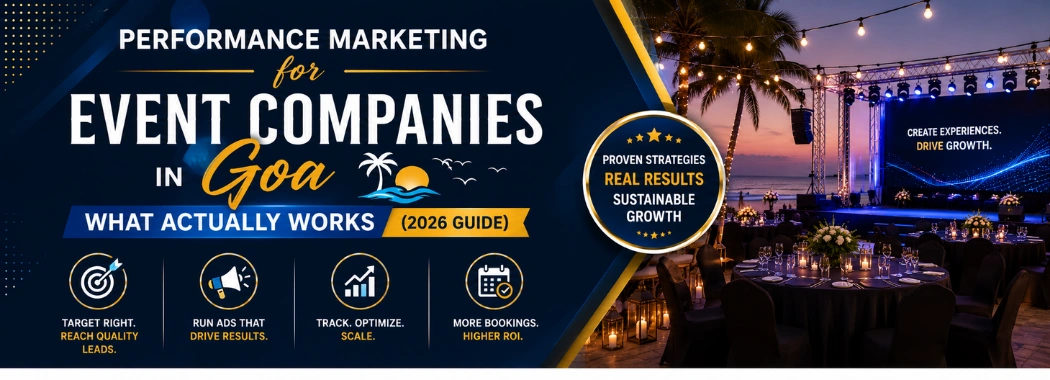
Most event companies in Goa run ads and call it performance marketing. Here’s what performance marketing actually means — and what it takes to make it generate real bookings consistently.
What’s Inside
- “Performance Marketing” Is One of the Most Misused Terms in Goa’s Event Industry
- Why “Performance Marketing” as Practiced by Most Agencies Fails Event Companies in Goa
- What Actual Performance Marketing Looks Like for a Goa Event Company
- Performance Marketing Metrics That Actually Matter for Goa Event Companies
- Goa-Specific Performance Marketing Considerations
- Frequently Asked Questions
- Performance Marketing That Performs — Not Just Runs
"Performance Marketing" Is One of the Most Misused Terms in Goa's Event Industry
Walk into a conversation with almost any digital marketing agency in India and ask them if they do performance marketing. Every single one will say yes.
Ask them to define it and you will hear variations of the same answer: running paid ads on Meta or Google, optimising for clicks or leads, reporting on cost per lead. It sounds rigorous. It sounds results-oriented.
For most event companies in Goa that have worked with these agencies, the actual experience looks different. Ads run. Leads arrive — sometimes in significant volume. The cost per lead metric looks acceptable. And yet, at the end of the month, the number of actual bookings generated is disappointing at best, zero at worst.
This is not a coincidence. It is the predictable outcome of a fundamental misunderstanding of what performance marketing means for an event business — and what it takes to make it actually perform. It is also the predictable outcome of hiring a generic digital marketing agency in Goa that applies the same campaign logic to an event company as it does to a restaurant chain or a retail brand — and expects the same results.
True performance marketing for an event company in Goa is not about generating the most leads for the lowest cost. It is about generating the highest-quality leads — prospects who have the budget, the event type, the timeline, and the location alignment to become real bookings — at a cost that makes economic sense relative to the value of those bookings.
That is a completely different objective. And achieving it requires a completely different approach from what most agencies mean when they say “performance marketing.”
This article is about what actually works — specifically for event companies in Goa, in a market where the buyer segments are distinct, the seasonality is extreme, the destination creates unique noise, and the booking values are high enough to justify a sophisticated approach.
Why "Performance Marketing" as Practiced by Most Agencies Fails Event Companies in Goa
The gap between what performance marketing promises and what it delivers for most Goa event companies can be traced to a set of specific structural failures — each of which is predictable once you understand the mismatch between how generic performance marketing is built and how event companies in Goa actually need to acquire clients.
The wrong performance metric.
Standard performance marketing optimises for cost per lead. Lower cost per lead is treated as better performance. But for an event company in Goa — where the difference between a serious booking enquiry and a tourism-influenced price inquiry is enormous — cost per lead is the wrong metric entirely. A ₹200 lead that converts to a ₹15 lakh wedding booking outperforms a ₹50 lead that converts to nothing by an incalculable margin. Optimising for cheap leads in a market like Goa produces exactly that: cheap leads, with minimal booking value.
The right performance metric for a Goa event company is cost per qualified lead — where “qualified” means screened for budget, event type, timeline, and location. This metric is harder to measure without a filtration system. Which is exactly why most agencies do not use it. Any event marketing agency in Goa serious about performance will tell you upfront that cost per lead is not the metric that matters — cost per qualified lead is.
The wrong audience definition.
Generic performance marketing for event companies typically uses broad audience parameters — people interested in weddings, people in a certain age range in certain locations. For Goa’s multi-segment event market, this approach fails differently depending on which segment is being targeted.
For the domestic destination segment: broad targeting reaches everyone interested in weddings, including couples planning local weddings with no interest in Goa as a destination. The destination-specific intent signal is missing. For the international segment: domestic-only targeting misses the segment entirely. NRI and international audiences are not being reached at all. For the corporate segment: wedding-oriented targeting reaches the wrong buyer entirely.
This is the core failure of working with a generic marketing agency in Goa that has no event-specific campaign architecture — they build one undifferentiated audience and call it targeting.
The wrong creative philosophy.
Performance marketing creative for event companies is most commonly built around promotional intent — an offer, a call to action, a reason to click. This approach ignores how event buying decisions are actually made. High-value event clients — particularly in Goa’s premium market — do not click ads because they were offered something. They engage because the creative showed them something that resonated with their specific aspiration or professional need. The creative philosophy must shift from promotional to resonant if the advertising is to perform at the level the market is capable of supporting.
The absence of a qualification layer.
This is the single most consequential missing element in almost every performance marketing setup for Goa event companies. When there is no mechanism between the ad click and the business owner’s time that screens for the four parameters that define a qualified lead — budget, event type, timeline, location — every lead that responds to an ad reaches the business equally. The serious buyer and the curious tourist. The high-budget destination wedding client and the low-budget local looking for the cheapest option.
Equal treatment of unequal leads is the structural failure that turns performance marketing from a growth engine into an expensive source of frustration. A specialist event marketing company in Goa builds this qualification layer into the system architecture from day one — not as an afterthought.
No closed-loop measurement.
Most performance marketing setups for event companies measure at the ad level — impressions, clicks, cost per lead. Very few measure what happens after the lead arrives. Which leads actually converted to consultations? Which consultations became bookings? What was the revenue generated per lead source, per campaign, per creative? Without this closed-loop measurement, the performance marketing system cannot be optimised for what actually matters — bookings — and it drifts toward optimising for the metrics that are easy to measure rather than the outcomes that actually matter.
Understanding these failures is what makes it possible to build something that genuinely performs.
What Actual Performance Marketing Looks Like for a Goa Event Company
Genuine performance marketing for an event company in Goa is an integrated system — not a collection of ad campaigns. It is built around a clear definition of performance (qualified bookings, not raw leads), a precise understanding of the buyer segments being targeted, and a closed-loop structure that connects advertising spend to actual business outcomes.
It operates on three integrated pillars.
Pillar 1: Authority Infrastructure — The Prerequisite That Most Performance Marketing Ignores
Here is the uncomfortable truth about performance marketing for event companies: no amount of targeting precision or bidding strategy makes a well-designed ad campaign perform if the destination it sends traffic to is not already authority-rich.
When a domestic destination couple in Mumbai clicks your ad, visits your Instagram profile, and finds inconsistent posting, generic content, and no visible proof of capability at the scale of their event — the click was wasted. When an international client in the UAE sees your ad, taps through to your website, and encounters a presentation that does not meet the standard they expect for an event worth lakhs — the lead is lost before it was ever gained.
Authority infrastructure — the content foundation that makes every click through from an ad arrive at a place that converts curiosity into genuine intent — is the prerequisite that most performance marketing frameworks treat as optional. It is not. For event companies in Goa specifically, where the buyer segments include international clients and premium domestic destination couples who are making high-stakes decisions based on digital signals alone, authority is the foundation that makes advertising profitable.
This is precisely the work that a specialist social media marketing agency in Goa working exclusively in the event niche does — not scheduling posts, but building every content piece to perform specific commercial work for a specific buyer segment.
Reels built around real event execution — showing complexity managed, logistics coordinated, visual outcomes delivered — communicate capability to a qualified prospect faster than any ad copy can. When the ad creative itself is drawn from this Reel library, the ad and the destination reinforce each other: the prospect sees the same level of quality from the first impression through to the profile visit and beyond.
For Goa’s market, Reels that use the destination’s visual identity strategically — not just as a beautiful backdrop, but as evidence of working in this specific environment, with these specific logistical realities, at these specific venues — carry a credibility signal that generic event content cannot replicate. A beach setup at Arambol filmed and edited with the quality that matches the event’s scale tells a prospective client three things simultaneously: you work in Goa, you work at this level, and you know what executing here actually involves.
Carousels serve a different but equally important function in the authority infrastructure. Where Reels communicate quickly and broadly, carousels communicate deeply and specifically. The carousel that walks through a complete Goa event from client brief to delivery — the planning decisions made, the vendor relationships managed, the contingencies handled, the result achieved — is the content that converts a genuinely interested prospect into a confident enquirer. This is particularly important for international clients and high-value domestic destination clients who are making significant investments based on digital evidence alone.
Stories maintain the continuous presence that keeps your brand in the peripheral awareness of your target audience throughout the extended research phase that characterises high-value event buying. A couple researching Goa wedding planners does not make a decision in one session. They research over weeks or months. The event company whose Stories they have been watching throughout that period arrives at the enquiry stage as a familiar, trusted presence rather than a new discovery.
Together, these three content formats build what authority infrastructure is designed to build: the conditions under which performance marketing can actually perform.
Pillar 2: Precision Campaign Architecture — Built for Goa’s Three Buyer Segments
With authority infrastructure in place, the campaign architecture can be built — and for Goa’s event market, this means three distinct campaign structures operating simultaneously, each designed for a specific buyer segment with its own targeting logic, creative strategy, and performance objectives.
This three-segment architecture is the defining characteristic of a genuine event marketing agency in Goa operating in this market — and the clearest indicator that the agency you are working with understands Goa’s specific buyer landscape rather than importing a generic campaign structure from another city or another industry.
Campaign Structure 1: Domestic Destination Buyers
This is the largest and most consistent segment for most Goa event companies — engaged couples and social event organisers in India’s major metros who are choosing Goa specifically because they want a destination experience.
Targeting parameters for this segment are built on the intersection of multiple intent signals. Life event signals (recent engagement, upcoming marriage), demographic parameters (age, income indicators), behavioural patterns (destination wedding content consumption, venue research behaviour, Goa-specific interest signals), and geographic concentration (Mumbai, Delhi NCR, Bengaluru, Hyderabad, Chennai, Pune — the source cities where the density of domestic destination clients is highest).
The creative for domestic destination campaigns leads with Goa’s aspirational identity — but grounds it in execution capability. The aspiration of a beach wedding at sunset in Vagator attracts the right audience. The visible proof that your company can execute that wedding at the level the aspiration demands is what converts the attraction into an enquiry.
Campaign timing is calibrated to the planning cycle: domestic destination couples researching November to February events are actively in the market from June through October. Running campaigns in this window — when most Goa event companies are dark — means being in conversations that competitors will not enter until it is too late.
Campaign Structure 2: International Clients
Geographic targeting on Meta allows reach into international markets — UK, US, Australia, UAE, Canada — where the NRI and international audience for Goa destination events is concentrated. This targeting is combined with demographic and interest parameters that identify the specific sub-segment most likely to be actively planning an India destination wedding or celebration.
The creative for international campaigns must meet a different standard. Production quality needs to be genuinely excellent — not good by Indian event industry benchmarks, but good by the standards of an audience that is comparing Goa to international destinations and applying international expectations to every signal they evaluate. Effective event promotion in Goa for this audience is built entirely around digital discovery — these clients are making major decisions thousands of kilometres away, and your content is doing work that a physical meeting would do in a local market.
International campaigns typically carry higher cost per lead than domestic campaigns — because the audience is geographically distributed and requires more sophisticated targeting parameters. The economics remain compelling because international bookings are among the highest-value in the entire Goa event market.
Campaign Structure 3: Corporate Retreat Decision-Makers
Corporate campaigns run on a fundamentally different logic from both wedding campaign structures. The audience is professional decision-makers — marketing managers, HR directors, operations heads, senior leadership — in the source cities where corporate event decisions for Goa offsites are made: Mumbai, Bengaluru, Delhi, Hyderabad.
Meta targeting for corporate audiences combines job function, seniority, industry, and company size parameters. LinkedIn advertising adds a professional channel layer that reaches the same decision-makers in their professional context — particularly valuable for senior decision-makers whose engagement with professional content happens primarily on LinkedIn rather than Instagram.
Corporate ad creative follows the professional problem-solution structure: specific, outcome-focused, capability-demonstrating. Case study creative that shows a specific corporate event managed at a relevant scale in Goa consistently outperforms brand awareness creative for this audience.
Corporate campaigns run year-round without seasonal pause — because corporate events in Goa happen in every month, including monsoon, and corporate planning cycles are not governed by the wedding season calendar. A specialist event marketing company in Goa builds this as a separate, always-on campaign stream — not an afterthought added to a wedding-focused account.
Unified performance measurement across all three structures:
Each campaign structure is measured independently — separate performance metrics, separate optimisation decisions, separate budget allocation reviews. But they are managed within a single system that provides a unified view of total qualified pipeline, total qualified bookings, and total revenue generated relative to total marketing investment.
This unified view is what makes it possible to make intelligent decisions about where to concentrate budget — which segment is generating the highest return per rupee of advertising spend, which creative approach is producing the most qualified leads, which audience parameters are most efficiently reaching genuinely serious buyers.
Pillar 3: The Lead Filtration System — Where Performance Marketing Becomes Accountable
This is where genuine performance marketing differs most fundamentally from the standard agency definition of the term.
Every enquiry generated across all three campaign structures passes through the AI-powered Lead Filtration System before it reaches the event company. The filtration operates on four parameters simultaneously: Budget. Event type. Timeline. Location.
Any enquiry that does not meet the criteria on all four parameters is filtered out automatically. No human time is invested. No response is sent. The enquiry simply does not reach the pipeline.
What does reach the pipeline — what appears in the dedicated mobile application available on iOS and Android — are pre-qualified, ready-to-book opportunities. Prospects who have demonstrated, through the intake process, that they meet every criterion that determines whether a conversation is genuinely worth having.
This is the accountability layer that makes performance marketing actually perform. And it is the layer that no generic digital marketing agency in Goa builds into their event client setups — because building it requires deep understanding of how the event booking cycle works, not just how to manage a Meta ads account.
Without this layer, the campaign system generates leads. With it, the campaign system generates a qualified pipeline of opportunities whose value can be measured in actual booking potential, not lead volume. Cost per lead becomes cost per qualified lead. Lead conversion rate becomes qualified lead conversion rate. The metrics that the system is optimised toward are the metrics that actually connect to business outcomes.
The mobile app delivers every qualified lead with full intake details already captured — event date, event type, budget range, location, specific requirements. The event company sees a complete picture of each opportunity immediately upon filtration clearance, without any additional qualification conversation required before the first call.
For corporate leads, where response speed directly influences booking probability, the instant notification and single-app visibility enables same-hour follow-up even when the event company is simultaneously managing an active event. The lead does not get lost in a crowded inbox while the team is on-site at Taj Exotica managing a 200-person conference.
Performance Marketing Metrics That Actually Matter for Goa Event Companies
Redefining performance for an event company requires redefining the metrics used to measure it. Here is the measurement framework that connects performance marketing activity to actual business outcomes.
Cost per qualified lead (CPQL): The total advertising spend divided by the number of leads that pass filtration on all four parameters. This is the primary efficiency metric — not cost per raw lead.
Qualified lead to consultation rate: The percentage of qualified leads that convert to a genuine planning conversation. This measures the quality of the filtration system and the speed and quality of the follow-up process.
Consultation to booking rate: The percentage of real planning conversations that convert to signed engagements. This measures the quality of the sales process and the alignment between what marketing promises and what the event company delivers.
Revenue per qualified lead: Total revenue from bookings attributable to the performance marketing system, divided by the number of qualified leads generated. This is the ultimate measure of system performance — the value being extracted from each qualified opportunity.
Segment-level ROAS (Return on Ad Spend): Revenue generated per segment relative to advertising spend allocated to that segment. This guides intelligent budget reallocation — concentrating spend toward the segments generating the highest return.
Pipeline velocity: The average time from qualified lead arrival to signed booking. Shorter pipeline velocity indicates better lead quality, better follow-up processes, and better alignment between what advertising promises and what the event company delivers in the first conversation.
Tracking these metrics monthly — not weekly, which introduces too much noise for a business with the booking cycle length of an event company — creates a feedback loop that drives continuous system improvement. The performance marketing system is not a set-and-forget operation. It is a continuously refined engine that gets better with every cycle of data.
Goa-Specific Performance Marketing Considerations
Monsoon campaigns outperform on value, not volume.
Running campaigns during June to September, when most Goa event companies are dark, produces lower lead volume but dramatically higher lead quality. The prospects engaging with performance marketing during monsoon are actively planning — they are not casual browsers on a holiday mindset. They are couples who have made a decision to get married in Goa and are now in serious vendor evaluation mode. The competition for their attention is minimal. The cost per click is lower. The quality of the engagement is higher. Monsoon campaigns are the highest-value advertising window in the Goa event calendar — and the least used.
Goa-specific creative signals outperform generic event creative.
Ads that reference Goa explicitly — in the visual, in the copy, in the venue context shown — consistently outperform generic event content for all three buyer segments. For domestic destination buyers, Goa-specific creative confirms the destination relevance of the ad. For international buyers, it reinforces the specific destination they are considering. For corporate buyers, it signals familiarity with the specific environment they are planning to use. This specificity is what separates genuine event promotion in Goa — built around Goa’s visual identity, its venues, its logistical reality — from generic event advertising that could be running for any destination.
Retargeting is disproportionately powerful in a long-consideration market.
Goa’s event buyers — particularly the domestic destination and international segments — have long consideration cycles. Couples may research for three to six months before making contact. Retargeting campaigns that re-engage people who have already shown interest — who visited the profile, watched a Reel, engaged with a carousel, or clicked a previous ad — are working with an audience that is already warm. In a long-consideration market, retargeting ROAS consistently exceeds prospecting ROAS by a significant margin. It should receive meaningful budget allocation in any Goa event company’s performance marketing setup.
Venue-specific creative performs differently by property.
For Goa event companies working with specific premium venues — The Leela, Taj Exotica, W Goa, Alila Diwa — creative that features these properties by name or by their distinctive visual identity outperforms generic Goa event creative for the audience that has already shortlisted these venues. Targeting prospects who have shown interest in these specific properties, with creative that shows your work in those environments, creates a relevance signal that generic destination advertising cannot replicate.
Frequently Asked Questions
Because they are often optimised for low-cost leads instead of qualified prospects, and lack a proper lead filtration system to separate serious inquiries from low-quality ones.
This is common with a generic marketing agency in Goa focused on volume over outcomes.
Focusing on cost per lead instead of cost per qualified lead, which leads to high volume but poor conversion outcomes.
It screens every inquiry based on budget, event type, timeline, and location, ensuring only serious and relevant prospects enter your pipeline.
By calculating revenue per qualified lead—dividing total revenue generated by the number of genuinely qualified inquiries.
Then your system lacks proper tracking and filtration, making it impossible to accurately measure or optimise performance.
Start with the segment where your portfolio is strongest, then expand gradually based on performance data and return on investment.
It requires a meaningful budget aligned with your business goals, but even moderate budgets can deliver strong returns in high-value markets like Goa.
Results depend on execution by a specialist event marketing agency in Goa.
Improvements begin within the first month, with significant gains visible over 2–3 months as targeting and data optimise.
Yes. Luxury campaigns focus on stricter lead qualification and higher creative standards, resulting in fewer but higher-value leads.
Performance-based models align incentives with actual bookings rather than just lead volume, ensuring focus on quality over quantity.
Performance Marketing That Performs — Not Just Runs
The word “performance” in performance marketing should mean exactly what it says: the system performs — it generates measurable, attributable business outcomes in the form of qualified bookings.
For most event companies in Goa, what is called performance marketing today is actually activity marketing — paid advertising that is running, generating metrics, and producing the appearance of marketing activity without producing the bookings that justify the spend.
The difference between activity marketing and genuine performance marketing for a Goa event company is the difference between optimising for cost per lead versus cost per qualified lead. Reaching a broad audience versus reaching precisely defined buyer segments. Generating enquiry volume versus generating a filtered pipeline of ready-to-book opportunities. Reporting on clicks and leads versus reporting on consultations, bookings, and revenue.
The Booking Engine is built around the second option in each of those pairs — because that is what “performance” should actually mean.
The event companies in Goa that are generating consistent, qualified bookings from their marketing spend are not working with a generic digital marketing agency in Goa applying a standard campaign template. They are working with a specialist event marketing agency in Goa that has built the entire system — authority infrastructure, precision campaign architecture, lead filtration — around how Goa’s specific event market actually works.
Book a free strategy call with The Boring Media. We will audit your current performance marketing setup — the targeting, the creative, the lead capture mechanism, the measurement framework — and show you exactly where the gap is between what your advertising spend should be delivering and what it is currently producing.
In Goa’s market, one high-value booking — a premium destination wedding, an international celebration, a recurring corporate retreat — can cover a year’s marketing investment. A performance marketing system that consistently delivers those bookings is not a cost. It is the highest-return investment your event company can make.
The Boring Media is a growth partner exclusively for event businesses in India. We work with event companies, wedding planners, event decorators, corporate event planners, and luxury event businesses across India — including Goa — to generate consistent, qualified, ready-to-book clients through the Precision Strike Machine: a three-step system built on authority content, precision performance marketing, and AI-powered lead filtration. Not Getting the Right Clients?
Let’s fix your lead flow and bring in people who are ready to pay.